
Free Lone Worker Risk Assessment Example
Download a free Lone Worker Risk Assessment template to help your organisation identify hazards, evaluate risks, and implement safety measures to protect lone and remote employees.

Why You Need a Lone Worker Risk Assessment
Every organisation employing lone, remote or high-risk workers has a legal and moral obligation to protect them. Our free Lone Worker Risk Assessment template will help you identify hazards, evaluate risks, and implement effective controls to ensure the safety and wellbeing of your workforce.
Download our free Lone Worker Risk Assessment Example Template to help complete a lone worker risk assessment, identify hazards, evaluate risks and meet UK HSE guidance for lone and remote workers.
Whether your staff work off-site, from home, in the community, or in isolation on company premises, you must carry out a lone worker risk assessment to meet your duty of care and ensure compliance with UK health and safety law.
This includes workers such as:
- Community nurses and social care staff
- Housing officers and surveyors
- Construction workers and engineers
- Delivery drivers and field sales teams
- Retail and hospitality employees working alone
- Homeworkers and remote workers
A well-structured lone working risk assessment (sometimes referred to as a lone working risk assessment) helps you:
- Identify potential hazards specific to working alone
- Assess the likelihood and severity of harm
- Put in place control measures to reduce risk
- Demonstrate compliance with HSE guidance
- Support safer working practices across all roles
What Are the Steps in a Lone Working Risk Assessment?
Carrying out a lone worker risk assessment helps you identify the hazards associated with working alone and put appropriate measures in place to reduce the risk of harm. While every organisation's assessment will be different, the process typically follows these six steps:
- Identify lone working activities – Consider which employees work alone, where they work, when they work, and the tasks they carry out.
- Identify potential hazards – Assess the hazards your lone workers may face, including environmental, physical, biological, chemical, ergonomic and psychosocial risks.
- Evaluate the level of risk – Determine how likely each hazard is to cause harm and the potential severity of the consequences.
- Implement control measures – Decide what actions can be taken to reduce risk, such as introducing safe working procedures, providing training, supplying personal safety devices or improving communication processes.
- Record your findings – Document the identified hazards, risk ratings, control measures and any actions required to ensure the assessment can be reviewed and followed consistently.
- Review the assessment regularly – A lone worker risk assessment should be updated whenever working practices change, new hazards emerge, or following an incident or near miss.
Our free Lone Worker Risk Assessment Template provides a structured framework to help you complete each of these steps and create a consistent, effective approach to protecting lone workers.
What’s Included in the Free Lone Worker Risk Assessment Template?
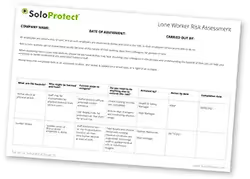
Our free downloadable risk assessment form provides an easy-to-follow structure based on industry best practice. It includes:
- Sections to describe the task or activity
- Hazard identification prompts
- Risk evaluation and scoring
- Mitigation/control measures
- Responsible person and review dates
- Template customisation for different lone worker roles
It’s suitable for all sectors and adaptable to specific work environments.
Read more about dynamic risk assessments in this blog: Dynamic Risk Assessments Explained
What Types of Lone Working Risks Should You Consider?
For help identifying workplace hazards, see our guide: 6 Types of Workplace Hazards and How to Spot Them
These may include:
- Safety hazards (e.g. slips, trips, faulty equipment)
- Environmental hazards (e.g. poor lighting, extreme temperatures)
- Biological hazards (e.g. exposure to viruses or bacteria)
- Chemical hazards (e.g. cleaning agents, flammable substances)
- Ergonomic hazards (e.g. manual handling, workstation setup)
- Psychosocial hazards (e.g. lone working, verbal abuse, stress)
Download the Lone Working Risk Assessment Template
This editable template can also be used as a lone worker risk assessment example, helping you understand the information typically included within a completed assessment.
Use this free lone working risk assessment template to:
- Establish a standardised approach to lone worker safety
- Comply with UK legislation and HSE lone worker guidance
- Reduce the risk of injury, incident or legal liability
- Promote a culture of safety and accountability
Simply complete the form and we'll send the editable template straight to your inbox.



A copy of the document will be sent to your email address. If you have any questions, then please contact us. Why not take a look at our other resources below.
Frequently Asked Questions
Risk Assessment Template FAQ
What is a lone worker risk assessment?
A lone worker risk assessment identifies the hazards faced by employees who work alone and evaluates the measures needed to reduce those risks. It helps organisations protect lone workers while meeting their legal duties under UK health and safety legislation.

How often should a lone worker risk assessment be reviewed?
A lone worker risk assessment should be reviewed whenever working practices change, new hazards are introduced, after an incident or near miss, or at regular intervals to ensure it remains accurate and effective.
What should be included in a lone worker risk assessment template?
A lone worker risk assessment template should include details of the work being undertaken, identified hazards, risk ratings, existing control measures, recommended actions, responsible persons and review dates. It should also be tailored to the specific risks associated with each lone working role.
.svg)

.avif)


